Urdu
Urdu Russia
 Turkey
 South Africa
You've got a brand new gas piping system installed in your lab. Shiny stainless steel tubes running across the ceiling, regulators mounted, terminal panels in place. Looks great. But here's the thing — none of it means anything until you've pressure tested every single joint and connection.
Why Pressure Testing Isn't Optional
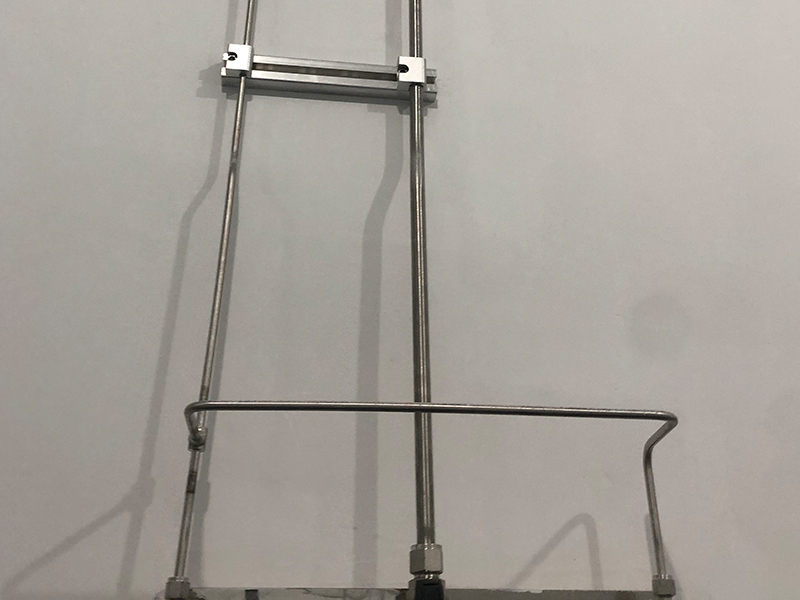
Every welded joint, every compression fitting, every valve connection is a potential leak point. And in a lab setting, even a tiny leak can be a serious problem. We're talking about high-purity gases where a pinhole leak doesn't just waste expensive gas — it lets ambient air and moisture into the system, contaminating everything downstream.
HJSLab, based in Suzhou, China, has commissioned gas piping systems in laboratories across Pakistan — from university research facilities in Lahore to pharmaceutical testing labs in Karachi. Our standard commissioning protocol goes well beyond basic leak checks.
HJSLab's Three-Stage Testing Protocol
Stage one is the strength test. We pressurize the entire system to 1.5 times the maximum operating pressure using dry nitrogen. For a system rated at 10 bar operating pressure, that means testing at 15 bar. We hold this pressure for a minimum of 30 minutes while monitoring the gauge. Any pressure drop — even 0.1 bar — means there's a leak somewhere that needs fixing before we move forward.
Stage two is the helium leak test. This is where we get serious. Helium atoms are incredibly small, second only to hydrogen. If helium can't escape, nothing else will either. We flood the system with a helium-nitrogen mix and scan every joint with a mass spectrometer leak detector. Our acceptance threshold is 1×10⁻⁹ mbar·L/s per joint. That's essentially zero leakage for all practical purposes.
Stage three is the purity verification purge. We flush the entire system with high-purity nitrogen, then sample the gas at each terminal point. Oxygen content must be below 1 ppm, moisture below 2 ppm. Only when every outlet passes these numbers do we sign off on the system.
What Makes Chinese-Manufactured Piping Reliable
All HJSLab gas piping systems use 316L stainless steel — BA grade for standard applications, EP grade for ultra-high-purity lines. Our Suzhou factory runs orbital welding machines with automated parameter control, and every weld gets inspected by borescope before the pipe leaves the shop.
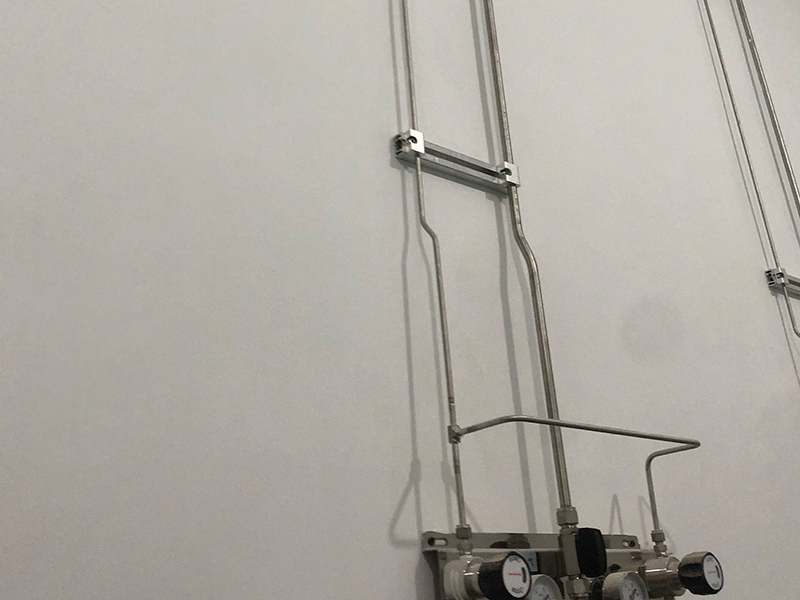
The cost advantage of sourcing from China is significant — typically 30-40% lower than equivalent European or American systems — but what matters more is consistency. Our ISO 9001 certified production line means every meter of pipe, every fitting, every valve meets the same specification whether it's going to a lab in Islamabad or a cleanroom in Faisalabad.
CPEC Makes Logistics Easier Than Ever
Thanks to the China-Pakistan Economic Corridor, shipping from our Suzhou facility to Pakistani ports has become faster and more cost-effective. Sea freight to Karachi takes about 15-20 days, and we handle all export documentation and customs clearance support. For urgent projects, we can also arrange air freight through direct China-Pakistan routes.
HJSLab doesn't just ship equipment and walk away. Our technical team provides remote commissioning guidance via video call, and for larger projects, we send engineers on-site to supervise installation and conduct the full testing protocol. Every system comes with a detailed commissioning report that your lab can use for regulatory compliance documentation under PSQCA requirements.